
Running a business requires a steady flow of cash. Fast Invoice Factoring: A Complete Guide to Getting Business Cash Quickly You may have completed a project, delivered products, or provided services, but what happens when your customers take 30, 60, or even 90 days to pay their invoices? Meanwhile, you still need to cover payroll, rent, supplies, and other operating expenses.
This is where fast invoice factoring can help. It allows eligible businesses to receive cash against outstanding customer invoices instead of waiting for the full payment period to end.
Invoice factoring can be useful for small businesses, contractors, transportation companies, wholesalers, and service providers that regularly sell to customers on credit. However, it is important to understand how the process works, what it costs, and whether it suits your financial situation.
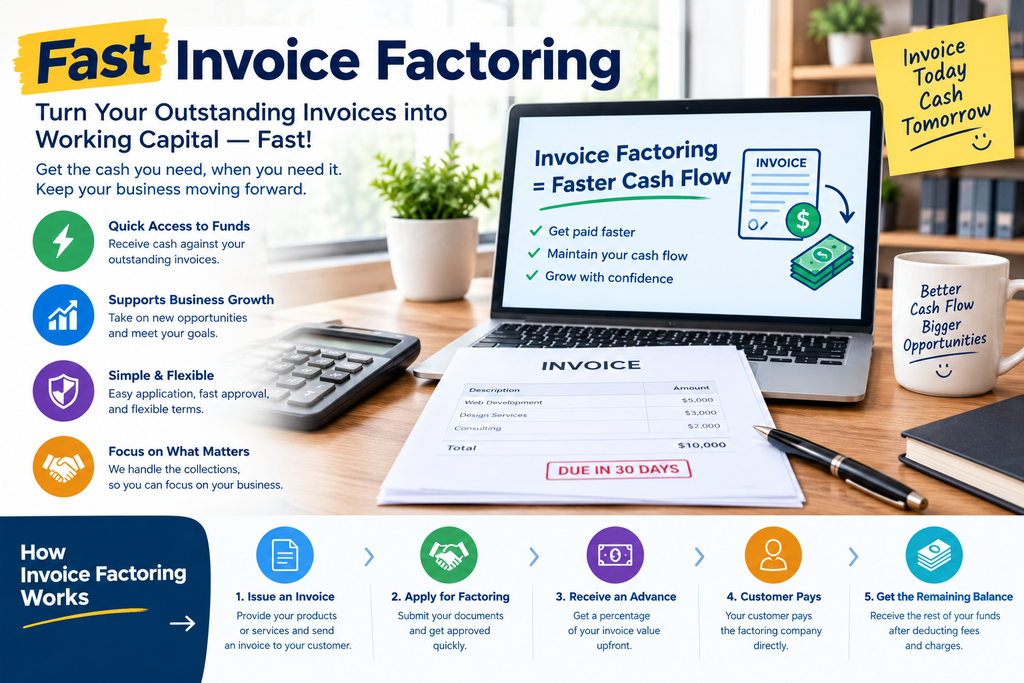
In this guide, we will explain invoice factoring, its benefits, approval requirements, potential costs, and how to choose a reliable factoring company.
What Is Fast Invoice Factoring?
Invoice factoring is a financing arrangement in which a business sells eligible unpaid invoices to a factoring company in exchange for an advance on their value.
Instead of waiting for a customer to pay an invoice, the business receives an agreed percentage of the invoice amount upfront. The factoring company then collects payment from the customer according to the arrangement.
Once the customer pays, the factoring company releases any remaining balance after deducting its fees and other applicable charges.
For example, imagine your business has issued a $10,000 invoice with payment due in 45 days. A factoring company might advance 85% of the invoice value, providing $8,500 upfront. The remaining amount would be settled after the customer pays, minus the agreed fees.
This is an illustrative example, not a guaranteed offer. Advance rates, fees, and payment timelines vary by provider, customer creditworthiness, invoice terms, and other factors.
How Does Fast Invoice Factoring Work?
The invoice factoring process generally involves several steps.
Step 1: Issue an Invoice
Your business provides products or services to a customer and issues an invoice with agreed payment terms.
The invoice should be accurate, supported by the underlying transaction, and eligible under the factoring company’s requirements.
Step 2: Apply to a Factoring Company
You submit an application and provide relevant business information. The provider may request invoices, customer details, business records, and bank information.
Many companies offer online applications, although approval speed depends on verification requirements and the complexity of the transaction.
Step 3: Receive an Advance
After approval and verification, the factoring company advances an agreed portion of the invoice value.
The timing can range from the same business day to several business days, depending on the provider and whether your account and invoices have already been approved.
Step 4: Your Customer Pays the Invoice
Under a typical factoring arrangement, your customer pays the factoring company directly. Some arrangements use different collection procedures, so you should confirm the payment process before signing.
Step 5: Receive the Remaining Balance
After the customer pays, the factoring company calculates the final settlement, deducts its fees, and releases any remaining funds to your business.
Understanding each step helps you estimate how much cash you will actually receive and when it will become available.
Benefits of Fast Invoice Factoring
Invoice factoring can help businesses manage cash flow when customer payments arrive later than operating expenses.
1. Faster Access to Working Capital
One of the main benefits is that businesses can access money tied up in unpaid invoices.
This cash may help cover supplier payments, fuel, equipment, employee wages, or other essential expenses without waiting for the customer’s payment deadline.
2. Support for Business Growth
A business may receive a large order but lack enough cash to purchase the materials needed to complete it.
Factoring eligible invoices can help companies manage working capital and take on suitable opportunities. However, businesses should carefully consider the cost before using factoring to fund expansion.
3. Potentially Flexible Qualification
Some factoring companies place significant emphasis on the creditworthiness of the business’s customers and the quality of its invoices.
This can make factoring an option for certain businesses that have limited borrowing history. Approval is never guaranteed, and providers may still review the applicant’s finances, operating history, and other risks.
4. Less Time Spent Waiting for Payments
Businesses with long customer payment cycles may use factoring to make cash flow more predictable.
Some providers also offer invoice administration or collection services. The level of support depends on the agreement, so review which responsibilities remain with your business.
Which Businesses Can Benefit From Invoice Factoring?
Invoice factoring is generally most relevant to businesses that invoice other businesses and regularly experience delayed payments.
Transportation and trucking: Freight companies may face fuel, maintenance, and driver expenses before customers pay freight invoices.
Construction and contracting: Contractors often complete work before receiving payment under commercial contracts.
Staffing agencies: Staffing businesses may need to pay employees weekly while clients pay invoices several weeks later.
Manufacturing and wholesale: Suppliers may need cash to purchase inventory and materials while waiting for business customers to settle invoices.
Professional services: Marketing agencies, consulting firms, and other service providers may issue invoices with extended payment terms.
Factoring is usually less suitable for businesses that primarily make immediate consumer sales or have few eligible outstanding invoices.
How Much Does Invoice Factoring Cost?
Invoice factoring fees vary according to the provider, invoice amount, payment period, customer risk, and contract terms.
Some companies charge a percentage of the invoice value, while others use fee structures that increase with the time an invoice remains unpaid. Additional charges may apply for administration, transfers, minimum usage, or other services.
For example, suppose a factoring company advances $8,500 against a $10,000 invoice. If the total agreed factoring fee is $300, the business would receive the remaining $1,200 after the customer pays, assuming there are no other deductions.
The total proceeds would be $9,700.
Before signing an agreement, ask for a clear breakdown of the advance rate, factoring fee, reserve amount, payment timing, and every additional charge. Compare the total cost with alternative financing options rather than looking only at the advertised fee.
How to Choose a Fast Invoice Factoring Company
Choosing a provider requires more than finding one that promises quick funding.
First, review the company’s funding process. Ask how long initial approval takes, how quickly new invoices are verified, and when funds are usually transferred.
Next, compare fees and contract terms. Check whether there are minimum monthly volumes, long-term commitments, termination charges, or restrictions on using other financing providers.
You should also understand whether the agreement is recourse or non-recourse. With recourse factoring, your business generally remains responsible for certain unpaid invoices. Non-recourse arrangements may protect against specified customer credit losses, but the protection is limited by the contract and does not necessarily cover disputes or defective invoices.
Finally, check the provider’s reputation, customer service, security practices, and collection procedures. Since the factoring company may communicate directly with your customers, professional handling of customer relationships is important.
Tips for Getting Invoice Factoring Approval Faster
Preparing your documents before applying can help reduce avoidable delays.
- Keep invoices accurate and up to date.
- Maintain signed contracts, purchase orders, and proof of delivery where applicable.
- Verify that invoices are owed by legitimate customers and are not subject to unresolved disputes.
- Organize business registration documents and requested financial records.
- Confirm that your customers accept the payment arrangement and notification requirements.
- Review the provider’s eligibility rules before submitting an application.
Complete documentation does not guarantee approval, but it can help the provider evaluate your application more efficiently.
Invoice Factoring vs. a Business Loan
Invoice factoring and traditional business loans both provide access to funds, but they work differently.
With invoice factoring, funding is tied to eligible unpaid invoices, and the factoring company typically collects payment from your customer. A business loan provides borrowed money that must be repaid under the loan agreement, usually with interest and applicable fees.
Factoring may be useful when a company has reliable business customers but struggles with long payment cycles. A loan may be more suitable when the business needs funding for expenses that are not directly linked to unpaid invoices.
The right choice depends on your cash flow, financing costs, eligibility, and future financial commitments.
Common Mistakes to Avoid
One common mistake is focusing only on funding speed. A provider may offer rapid advances but charge fees that reduce your profit significantly.
Another mistake is overlooking contract restrictions. Some agreements require businesses to factor a minimum volume of invoices or commit to a specific term.
Businesses should also avoid factoring disputed invoices or invoices that have already been pledged to another lender without confirming that the arrangement is permitted.
Finally, do not assume that non-recourse factoring eliminates every risk of nonpayment. Read the agreement carefully and understand exactly which circumstances are covered.
Conclusion
Fast invoice factoring can help businesses turn eligible unpaid invoices into working capital without waiting for customers to complete their normal payment cycles. It may be particularly valuable for trucking companies, contractors, staffing agencies, wholesalers, and other businesses that regularly invoice commercial customers.
However, factoring is not free money. Advance rates, fees, contract conditions, and customer payment risks all affect whether it is a sensible choice.
Before choosing a provider, compare the total cost, verify the funding timeline, understand recourse provisions, and review the agreement carefully. With the right arrangement, invoice factoring can help a business manage short-term cash flow needs while continuing to serve customers and pursue growth opportunities.