
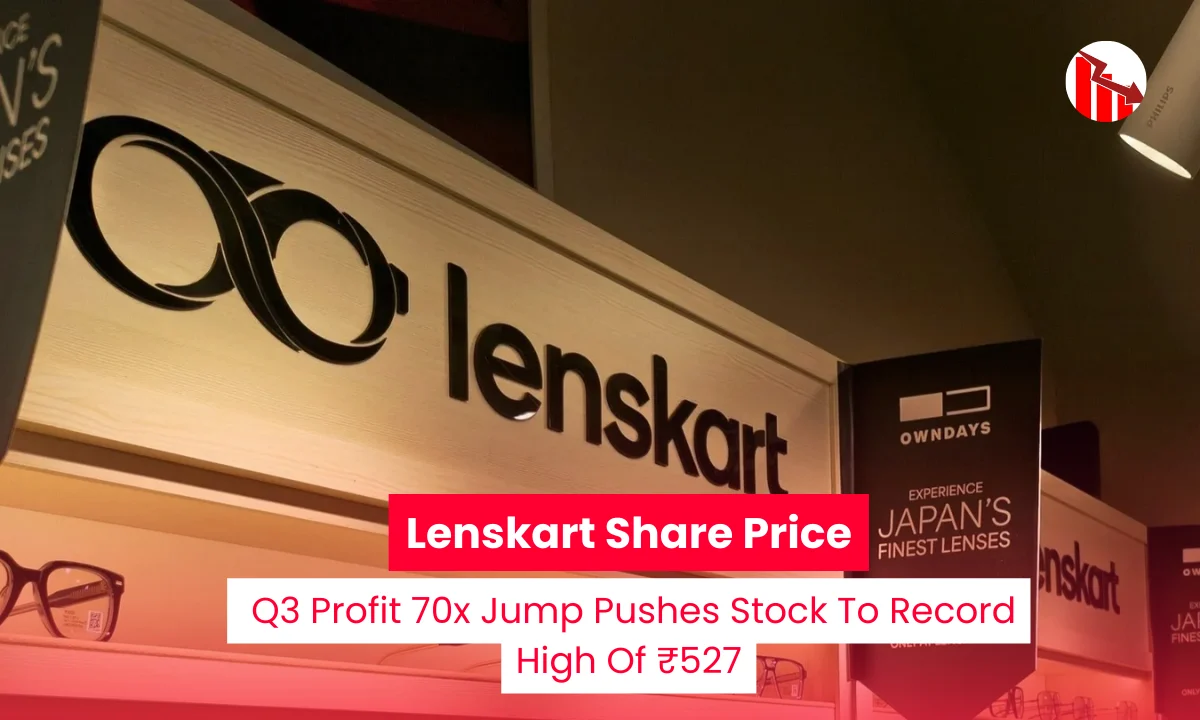
Lenskart share price is trending across market platforms after Lenskart Solutions Ltd surged to a fresh 52 week high of ₹527.30 on February 12, 2026. Strong Q3 FY26 results triggered heavy buying interest across exchanges including National Stock Exchange of India. Investors are now closely tracking whether the rally has more room to run or if the stock is entering overvaluation territory.
The eyewear major delivered sharp revenue growth, margin expansion, and a massive jump in net profit. Volumes spiked nearly 14 times the recent average, signaling institutional participation. The market reaction signals confidence, but valuation metrics are also raising questions about sustainability.
Key Takeaways
- Lenskart share price touched a record ₹527.30 intraday
- Q3 FY26 net profit jumped to ₹132.7 crore from ₹1.9 crore YoY
- Revenue rose 38% YoY to ₹2,307 crore
- EBITDA margin expanded to 20%
- 195 new stores added in Q3
- Same store sales growth at 28%
- P/E ratio remains elevated above 175x
- Market cap stands near ₹87,000 to ₹89,000 crore
Company Background And Business Model
Before evaluating the rally, it is important to understand the company.
Lenskart operates a vertically integrated omnichannel model combining online sales with over 3,000 stores globally. The company designs, manufactures, distributes, and retails eyewear products under its own brands. This vertical integration improves gross margins and ensures better quality control.
Its manufacturing facilities in India play a key role in cost efficiency. Technology integration is central to its strategy. AI driven personalization, 3D try on features, and digital eye testing tools enhance customer experience.
The company also runs a Gold membership program that drives repeat purchases and customer stickiness. Reported Net Promoter Score stands at 80.9, which reflects strong customer satisfaction.
This tech enabled retail approach differentiates Lenskart from traditional eyewear chains.
Also Read: TCS Share Price Crash: AI Shock, ₹10 Lakh Crore Market Cap Breach And What Investors Should Know
IPO And Post Listing Journey
Lenskart Solutions Ltd listed on November 10, 2025 at ₹402 per share. The debut was relatively stable with limited premium. Initial weeks saw consolidation amid broader market volatility.
However, consistent quarterly execution changed investor perception. The stock gradually moved higher as profitability visibility improved.
As of February 12, 2026:
| Metric | Data |
|---|---|
| IPO Price | ₹402 |
| Previous Close | ₹467.60 |
| Day High | ₹527.30 |
| Day Low | ₹500 |
| 52 Week Low | ₹356.10 |
| 52 Week High | ₹527.30 |
| Market Cap | ₹87,000 to ₹89,000 Cr |
| P/E Ratio | 175x to 231x |
| Book Value | ₹36.6 |
| Dividend Yield | Nil |
The stock is now up approximately 25 to 31 percent from IPO levels. The breakout above ₹500 came with strong volume confirmation, which technical traders interpret as bullish momentum.
Q3 FY26 Results That Triggered The Rally
The biggest driver behind the rally is earnings momentum and operating leverage.
Revenue Growth
Revenue from operations came in at ₹2,307 crore, reflecting 38 percent year on year growth.
- India revenue growth: 40.4%
- International revenue growth: 32.7%
Growth was supported by new store additions, higher ticket sizes, and strong demand in both urban and semi urban markets.
Net Profit Explosion
Net profit stood at ₹132.7 crore compared to ₹1.9 crore in the same quarter last year. This represents nearly a 70x increase.
Sequential profit growth was about 28 percent, indicating improving operational efficiency rather than a one off gain.
EBITDA And Margin Expansion
EBITDA margin expanded to 20 percent. Margin improvement was driven by:
- Better store productivity
- Improved supply chain efficiencies
- Higher contribution from owned brands
- Operating leverage from scale
International EBITDA margin improved to 6.1 percent over nine months, signaling a transition toward sustainable overseas profitability.
Store Expansion And Operational Scale
Store expansion remains a core growth engine.
In Q3 alone, the company added 195 stores:
- 169 stores in India
- 26 stores internationally
The international store count stands at 705. The company uses GeoIQ algorithms to optimize store placement and reduce cannibalization.
Operational metrics were equally strong:
- 60 lakh eye tests conducted in Q3
- Nearly 50 percent were first time tests
- Same store sales growth: 28 percent
- Same pincode sales growth: 36 percent
These metrics show both expansion and depth in existing markets.
The Indian eyewear market is estimated at ₹79,000 crore. The broader need based opportunity is estimated above ₹4 lakh crore, with over 500 million people requiring vision correction. This provides a long runway for growth.
Valuation Deep Dive And Peer Comparison
Valuation is where the debate intensifies.
At 175x to 231x earnings, the stock trades at a significant premium to traditional retail players. The premium reflects expectations of 25 to 30 percent long term CAGR growth.
Compared to Titan Eye+ under Titan Company Limited, Lenskart has faster growth but lower legacy brand equity. Global peer Warby Parker also trades at premium valuations due to its direct to consumer model.
Investors are effectively pricing in:
- Continued revenue compounding above 30 percent
- Sustained margin expansion
- International scale up success
- Technology led competitive advantage
Any slowdown in growth could lead to valuation compression.
Growth Drivers And Future Outlook
Key structural growth drivers include:
- Massive underpenetrated vision correction market in India
- Rapid store rollout strategy
- International expansion in UK, Europe, and Asia
- AI powered personalization tools
- Entry into adjacent categories such as smart eyewear
Brokerage reports suggest target prices in the ₹575 to ₹600 range. These projections assume margin sustainability near 20 percent and consistent revenue momentum.
Management commentary from CEO Peyush Bansal highlights operating leverage, cost discipline, and international playbook replication as strategic priorities.
Valuation Concerns And Risks
Despite strong numbers, risks remain.
- High valuation leaves limited margin of safety
- Dependence on global supply chains including China sourcing
- Execution risk in scaling international operations
- Regulatory scrutiny in overseas subsidiaries in past periods
- No dividend payout as profits are reinvested
High growth companies often face volatility if quarterly expectations are not met.
Public Opinion On Social Media
Discussions on platforms including X show strong bullish sentiment following results.
Retail investors highlight breakout above 52 week high and strong volumes. However, some experienced investors caution that elevated P/E multiples demand flawless execution.
The narrative has shifted from startup valuation concerns to sustainable profitability discussions.
FAQs
Should investors buy Lenskart at ₹500 plus levels?
Valuation is demanding. Long term investors may consider staggered entry based on risk appetite. Short term traders are focusing on momentum.
Is the Q3 profit sustainable?
Margin expansion and operating leverage suggest structural improvement. However, monitoring Q4 performance will be critical.
Does Lenskart pay dividends?
Currently, the company does not pay dividends. Profits are reinvested into expansion and technology.
What should investors track next?
Watch same store sales growth, international EBITDA margins, store addition pace, and management guidance.
What To Watch Next
Investors will track:
- Q4 FY26 earnings momentum
- Margin sustainability above 18 to 20 percent
- International profitability ramp up
- Volume trend and price stability above ₹500
- Any strategic announcements or acquisitions
Real time prices can be checked on NSE India, Moneycontrol, Groww or Yahoo Finance.
Final Outlook On Lenskart Share Price
Lenskart share price has entered strong momentum territory after Q3 FY26 results. Revenue growth, profit expansion, and operating efficiency are clearly visible.
The business fundamentals appear stronger compared to pre IPO expectations. However, valuation remains rich and sensitive to earnings performance.
If the company sustains 25 to 30 percent growth with stable margins, the premium multiple may hold. If growth moderates, volatility could increase.
Investors must balance opportunity with risk before making decisions. This article is for informational purposes only and not investment advice.
Tags: Lenskart share price, Lenskart Q3 results, Lenskart IPO, NSE Lenskart, Eyewear stocks India, Indian stock market news, Lenskart financial results