
The 8th Pay Commission officially came into effect from January 1, 2026, after the 7th Pay Commission ended on December 31, 2025. Since then, central government employees and pensioners have been closely tracking every update related to salary revision, allowances, and pension changes.
The commission is chaired by Ranjana Prakash Desai and its recommendations will impact more than 50 lakh serving employees and around 60 lakh pensioners. Even though the commission has started its work, the actual salary hike is not immediate, which has created both excitement and frustration among employees.
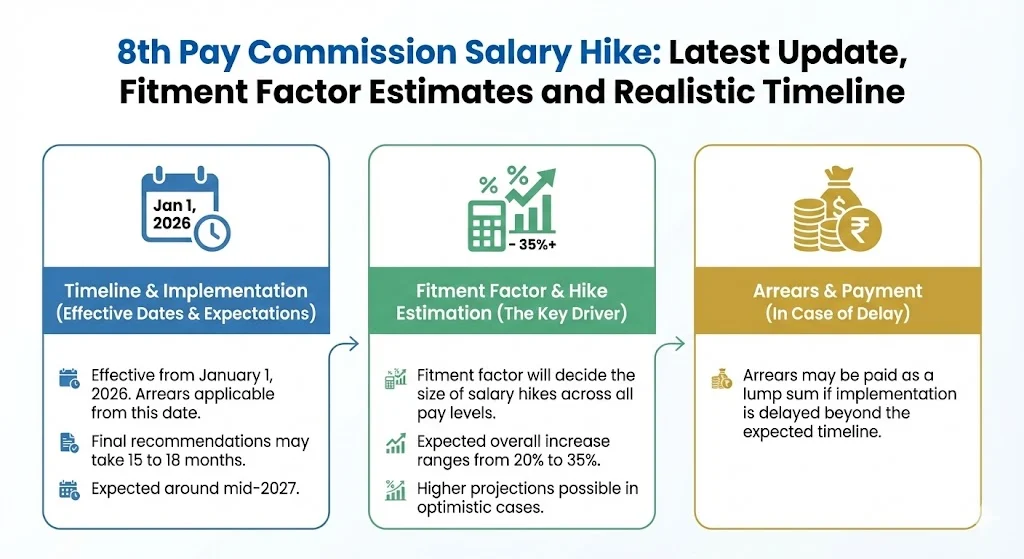
Table of Contents
Key takeaways
- The 8th Pay Commission is effective from January 1, 2026, with arrears applicable from this date
- Final recommendations may take 15 to 18 months and are expected around mid 2027
- Fitment factor will decide the size of salary hikes across all pay levels
- Expected overall increase ranges from 20 to 35 percent, with higher projections in optimistic cases
- Arrears may be paid as a lump sum if implementation is delayed
What the 8th Pay Commission covers
The scope of the 8th Pay Commission is wider than just basic salary revision. It includes a review of pay structure, allowances, and pension benefits. Once the commission submits its report, the central government will examine the recommendations before giving final approval.
Only after this approval will revised salaries be credited. This process explains why employees may not see an immediate increase even though the commission is already in effect.
How salary revision works under a pay commission
Salary revision under any pay commission is driven mainly by the fitment factor. This factor acts as a multiplier on the existing basic pay. The result becomes the new basic salary under the revised pay structure.
During the 7th Pay Commission, the fitment factor was fixed at 2.57. Because of this, a basic pay of Rs 7,440 under the 6th Pay Commission was revised to Rs 18,000. The same method will be used for the 8th Pay Commission as well.
Also Read: Income Tax Refund News January 2026: Why Lakhs of Taxpayers Are Still Waiting
Expected fitment factor in the 8th Pay Commission
Based on expert opinions, union demands, and recent discussions, the fitment factor for the 8th Pay Commission is likely to fall within a specific range.
Most realistic estimates place the fitment factor between 1.9 and 2.57. Some employee unions are demanding a higher factor of 2.86 or even 3.0. However, such figures are considered optimistic and may face resistance due to fiscal pressure.
A uniform fitment factor across pay levels is expected, similar to previous commissions.
Projected salary hike with a 2.15 fitment factor
If the fitment factor is fixed at 2.15, salaries will see a moderate rise. This scenario is often considered a conservative estimate.
- Level 1 entry level Group D employee
Current basic pay: Rs 18,000
Revised basic pay: Rs 38,700
Increase: Around Rs 20,700 - Level 10 entry level Group A officer
Current basic pay: Rs 56,100
Revised basic pay: Rs 1,20,615
Increase: Around Rs 64,515 - Level 18 senior most Group A officer
Current basic pay: Rs 2,50,000
Revised basic pay: Rs 5,37,500
Increase: Around Rs 2,87,500
Projected salary hike with a 2.57 fitment factor
A fitment factor of 2.57 is seen as a balanced outcome since it matches the previous pay commission. Many employees consider this a reasonable expectation.
- Level 1 entry level Group D employee
Current basic pay: Rs 18,000
Revised basic pay: Rs 46,260
Increase: Around Rs 28,260 - Level 10 entry level Group A officer
Current basic pay: Rs 56,100
Revised basic pay: Rs 1,44,177
Increase: Around Rs 88,077 - Level 18 senior most Group A officer
Current basic pay: Rs 2,50,000
Revised basic pay: Rs 6,42,500
Increase: Around Rs 3,92,500
Projected salary hike with a 2.86 fitment factor
A 2.86 fitment factor represents the most optimistic scenario currently being discussed on social platforms. Employee unions pushing for this figure argue that it is necessary to offset inflation and rising living costs.
- Level 1 entry level Group D employee
Current basic pay: Rs 18,000
Revised basic pay: Rs 51,480
Increase: Around Rs 33,480 - Level 10 entry level Group A officer
Current basic pay: Rs 56,100
Revised basic pay: Rs 1,60,446
Increase: Around Rs 1,04,346 - Level 18 senior most Group A officer
Current basic pay: Rs 2,50,000
Revised basic pay: Rs 7,15,000
Increase: Around Rs 4,65,000
Allowances and take home salary impact
Once the new basic pay is fixed, allowances such as house rent allowance, travel allowance, and other linked benefits are recalculated. In many projections shared online, total take home salary increases by 25 to 50 percent after including allowances.
This is why even a moderate increase in basic pay can significantly improve monthly income.
Arrears payment and timeline clarity
Since the 8th Pay Commission is effective from January 1, 2026, any delay in implementation will lead to arrears. These arrears may cover more than 15 months depending on when the government approves the recommendations.
Historically, arrears are paid in one or multiple lump sums. Employees are already factoring this into their financial planning.
Public reaction and debate on social platforms
Recent discussions on X show mixed reactions. Government employees express hope that the commission will restore purchasing power and narrow the gap with private sector salaries. Many users share unofficial salary charts and calculation methods daily.
At the same time, criticism is visible from taxpayers and private sector professionals. Concerns focus on fiscal burden, inflation risk, and lack of productivity reforms. Some argue that salary hikes should be linked with accountability measures.
State level developments and ripple effects
Assam has already become the first state to announce the formation of its own 8th Pay Commission. This move has triggered discussions in other states, public sector units, and banking institutions.
If more states follow, the impact of the 8th Pay Commission could extend beyond central government employees.
What Employees Should Realistically Expect?
Despite the buzz, it is important to separate speculation from timelines. The commission is still reviewing data and stakeholder inputs. Final recommendations are likely by mid 2027.
Actual salary credit may come later, but arrears will compensate for the delay. Until then, projections should be treated as estimates, not confirmed figures.
Final outlook on the 8th Pay Commission salary hike
The 8th Pay Commission is shaping up to be one of the most closely watched salary revisions in recent years. Rising inflation, political timing, and public debate have all added to the attention.
While expectations remain high, the final outcome will depend on the fitment factor and the government’s fiscal stance. For now, employees should stay informed and focus on realistic scenarios rather than viral calculations.
Also Read: Hindustan Zinc Share Price Rallies to Record High on Strong Q3 FY26 Results and Silver Surge
Tags: 8th Pay Commission, central government salary hike, fitment factor 8th CPC, government employees salary, pay commission update, pension revision
[…] Also Read: 8th Pay Commission Salary Hike: Latest Update, Fitment Factor Estimates and Realistic Timeline […]