
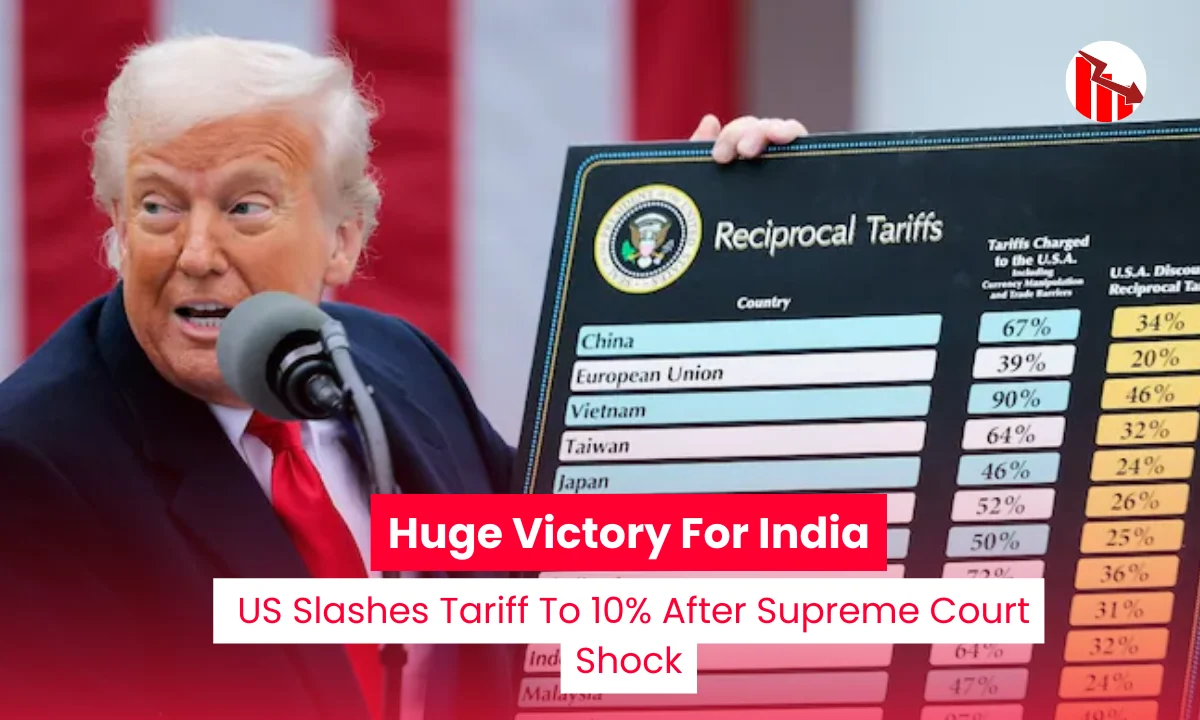
The big headline right now is simple. US tariff on India is now 10%. Not 18%. Not 25%. Just 10% for the next 150 days. After the US Supreme Court rejected former President Donald Trump’s sweeping emergency tariffs, Washington moved quickly and announced a temporary 10% global import surcharge.
For India, this is being seen as a huge relief. Earlier discussions around higher reciprocal tariffs had created uncertainty for exporters. Now, with the tariff rate reduced to 10%, Indian businesses get breathing space. But is this a permanent win or just a temporary pause in the tariff war. Let us break it down in simple terms.
Key Takeaways
- US Supreme Court struck down Trump’s emergency tariffs imposed under IEEPA
- US announced a temporary 10% global tariff under Section 122 for 150 days
- India’s tariff exposure reduced from 18% to 10%
- No final India US trade deal signed yet, only framework discussions
- Refunds of earlier tariff collections may take years in courts
- Sector specific tariffs under Section 232 remain unaffected
- Global trade uncertainty still continues
Why Did The US Supreme Court Reject Trump’s Tariffs
The turning point came when the Supreme Court of the United States ruled 6–3 against the tariff strategy used by Donald Trump.
Trump had relied on the International Emergency Economic Powers Act or IEEPA. This 1977 law allows emergency actions during national crises. But the Court said clearly that IEEPA does not authorize the President to impose sweeping tariffs.
Chief Justice John Roberts wrote that taxation powers belong to Congress. The President cannot unilaterally impose unlimited tariffs without clear approval. This verdict is significant. It reinforces separation of powers in the US system.
What Changed For India After The Ruling?
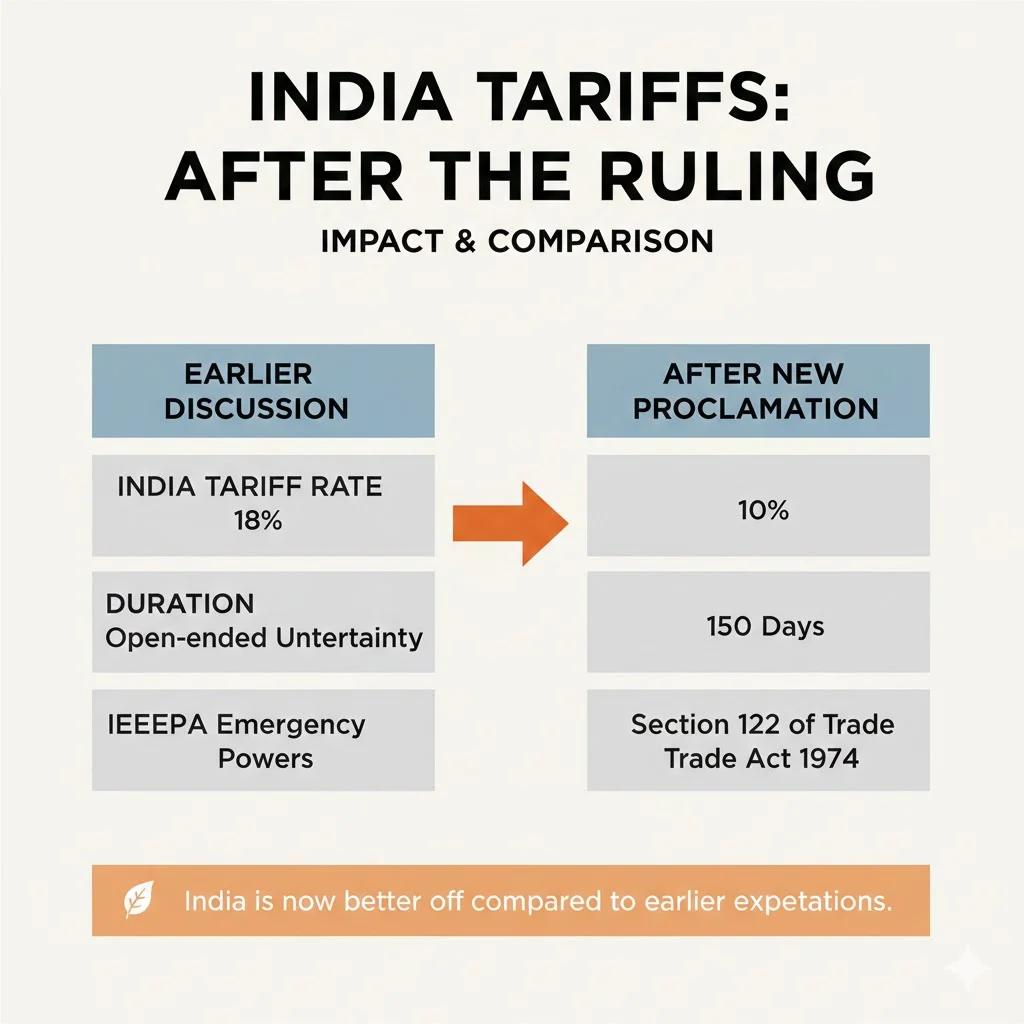
Earlier, India was facing discussions around 18% reciprocal tariffs. In some sectors, there were even threats of additional punitive tariffs linked to oil purchases.
After the ruling, the White House issued a proclamation. It imposed a uniform 10% temporary import surcharge on almost all countries for 150 days starting February 24.
Here is a quick comparison.
| Scenario | Earlier Discussion | After New Proclamation |
|---|---|---|
| India Tariff Rate | 18% | 10% |
| Duration | Open ended uncertainty | 150 days |
| Legal Basis | IEEPA emergency powers | Section 122 of Trade Act 1974 |
| Nature | Country specific | Global uniform tariff |
So technically, India is now better off compared to earlier expectations.
Is This A Final Trade Deal Between India And US
Short answer. No. There is no signed comprehensive trade agreement yet between India and United States.
What exists is an interim framework. Discussions are ongoing. Officials from both sides are expected to meet and negotiate sector wise terms. Agriculture, digital trade, energy imports, and market access remain sensitive topics.
So the Supreme Court ruling does not cancel or finalize any India US trade deal. It simply changes the tariff landscape temporarily.
What About Section 122, 301 And 232 Tariffs
After losing under IEEPA, Trump moved to Section 122 of the Trade Act of 1974. This provision allows up to 15% tariffs for 150 days in case of balance of payments issues.
But other tariff tools remain active.
- Section 232 allows sector specific tariffs on steel, aluminium, automobiles
- Section 301 allows investigation into unfair trade practices
- These powers are separate from IEEPA
That means trade tensions are not fully over. The method changed. The policy intent remains.
Impact On Indian Exporters
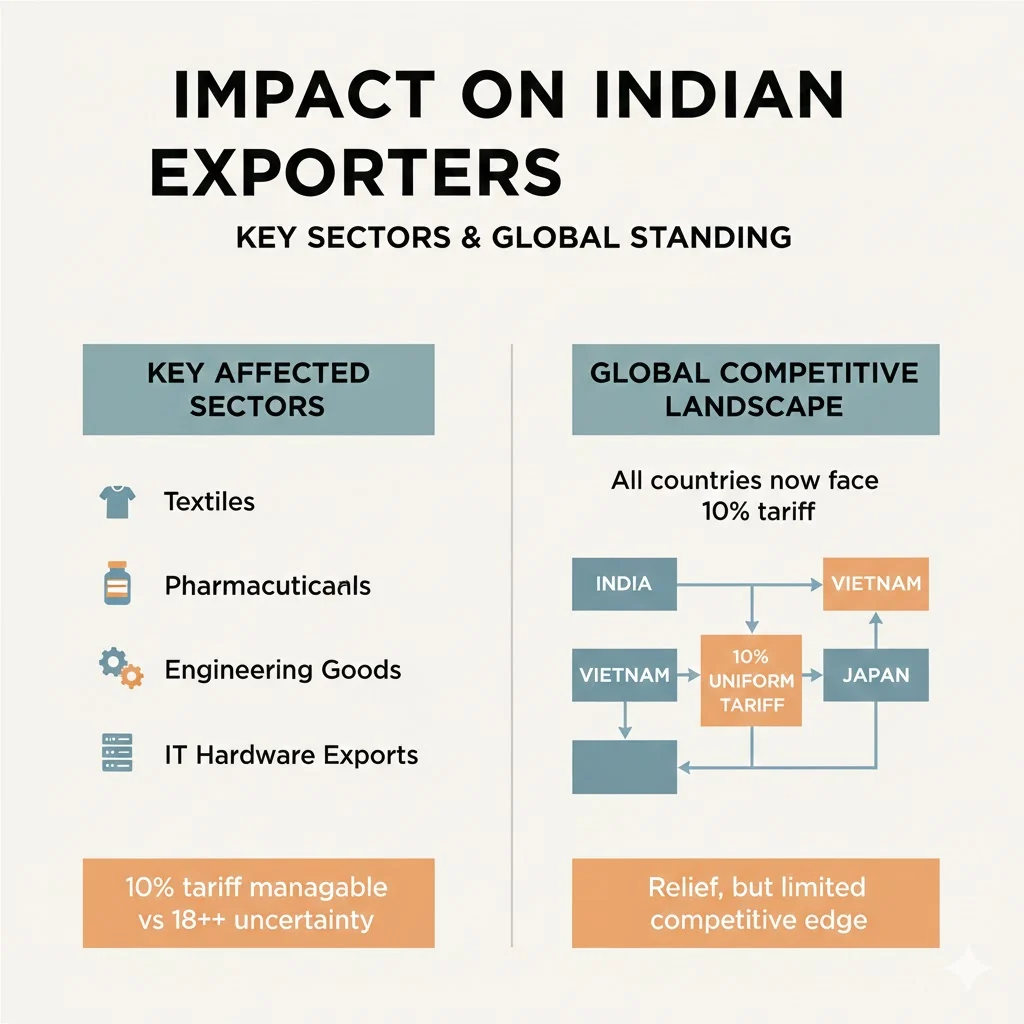
Indian exporters welcomed the decision. Organizations like export associations see this as restoring predictability.
Key sectors affected:
- Textiles
- Pharmaceuticals
- Engineering goods
- IT services related hardware exports
A 10% tariff is still a cost. But compared to 18% or higher uncertainty, it is manageable. Pricing models can adjust.
However, since all countries now face 10%, India’s relative advantage over others is limited. Vietnam, EU, Japan also see reset to 10%. So it is relief, but not a massive competitive edge.
What Happens To The Billions Already Collected
Economists estimate over 175 billion dollars were collected under earlier tariffs. The Supreme Court did not directly address refund mechanisms. Legal experts say companies will have to sue individually for refunds. Cases may drag for years.
Even Trump suggested refund litigation could last two to five years. So businesses should not expect automatic refunds.
Public Opinion On X And Global Reaction
On social media platform X, reactions are mixed.
Indian users largely see it as a diplomatic win. Many believe India stayed patient and avoided rushing into a one sided agreement.
In the US, political reactions are divided. Some Democrats praised the Court for defending constitutional balance. Some Republicans criticized the ruling and supported alternative tariff routes.
Global partners like Canada, Germany and UK expressed cautious optimism. But most governments said they are waiting to see what Washington does next. The mood globally is simple. Stability is needed. Policy flip flops create confusion.
Is This Really A Huge Victory For India
Let us be realistic.
Yes, India avoided higher tariffs.
Yes, rate reduced from 18% to 10%.
Yes, legal clarity improved.
But:
- 10% tariff still exists
- Only valid for 150 days
- New investigations under Section 301 may come
- Trade deal negotiations are still pending
So calling it a historic win may be slightly emotional. Calling it strategic relief sounds more accurate. India now negotiates from a more stable position. That is the real advantage.
What To Watch Next?
Here is what matters in coming weeks:
- Will US extend 10% tariff beyond 150 days
- Will Section 301 investigations target specific countries
- Will India US interim trade framework convert into final agreement
- How will global markets respond
Trade policy today is not just economics. It is geopolitics, elections, and strategic positioning.
Final Thoughts
The US Supreme Court verdict reshaped global trade dynamics overnight. India’s tariff exposure reduced from 18% to 10%, offering short term relief to exporters.
But global trade uncertainty is far from over. Policy tools remain available to Washington. Negotiations remain ongoing. Markets remain cautious.
For now, India has avoided a tougher tariff blow. That itself is meaningful. The next 150 days will decide whether this was a temporary pause or the beginning of a more balanced India US trade chapter.