

The Rule of 20 is a well known way to judge if the stock market looks fairly valued or stretched. It compares the Price to Earnings ratio with the rate of inflation. When the total of these two figures sits close to 20, the market is often seen as fairly priced. When the number rises much above 20, investors start to question future returns.
Key Takeaways
- Rule of 20 compares P/E and inflation together
- A reading near 20 suggests fair valuation
- Higher readings suggest stretched markets
- Strong earnings growth can still support higher prices
- Investors today focus more on growth quality
- Current readings indicate caution in 2026
Also Read: Master These 15 Unbeatable Rules To Be Undefeated In Investing & Budgeting
In recent years, the Rule of 20 reading has remained elevated. Strong earnings growth has kept markets supported, even as valuations remain high. This creates a debate between risk awareness and optimism about long term growth trends.
Understanding the Rule of 20
The traditional Rule of 20 says the stock market is fairly valued when:
P/E Ratio + Inflation Rate = 20
If the total is below 20, the market may be undervalued. If the total is above 20, the market may be overvalued. This guideline uses the idea that higher inflation normally justifies lower P/E ratios, since rising prices impact returns and borrowing costs.
Over long periods, this simple valuation rule has often lined up with broad valuation cycles. Historically, the average P/E has sat near the mid teens, while inflation averaged near 4 percent. Together this created a long term average reading close to 20.
Today, however, markets trade at higher levels than this long term pattern.
Current Market Readings Show Persistent Overvaluation
Recent market data at the start of 2026 shows P/E ratios well above historical averages. Valuations remain elevated, helped by strong demand for earnings growth, especially in sectors driven by artificial intelligence.
Market Metrics (Early 2026)
| Metric | Current Reading |
|---|---|
| S&P 500 trailing P/E | ~28–31 |
| S&P 500 forward P/E | ~24–27 |
| Shiller CAPE | 40+ |
| Inflation (YoY) | ~2–4% |
When the Rule of 20 is calculated using these numbers, the total level sits near 26–30 or even higher. This suggests the market remains richly valued and offers less margin for error. The metric is still above fair value levels seen in earlier decades.
Many analysts caution that this does not automatically mean an immediate correction. Instead, it signals lower expected long term returns unless earnings continue to grow strongly.
Why This Rule Appears Less Reliable Recently
The past few years show that high valuations do not always result in sharp declines. AI adoption, liquidity support, and strong profits have allowed stocks to hold higher P/E ratios. Supporters say companies will grow earnings fast enough to justify today’s prices.
However, this also means the market depends heavily on continued growth. Any slowdown in earnings or persistent higher interest rates could reset expectations. This creates higher sensitivity to negative earnings surprises during 2026 and beyond.
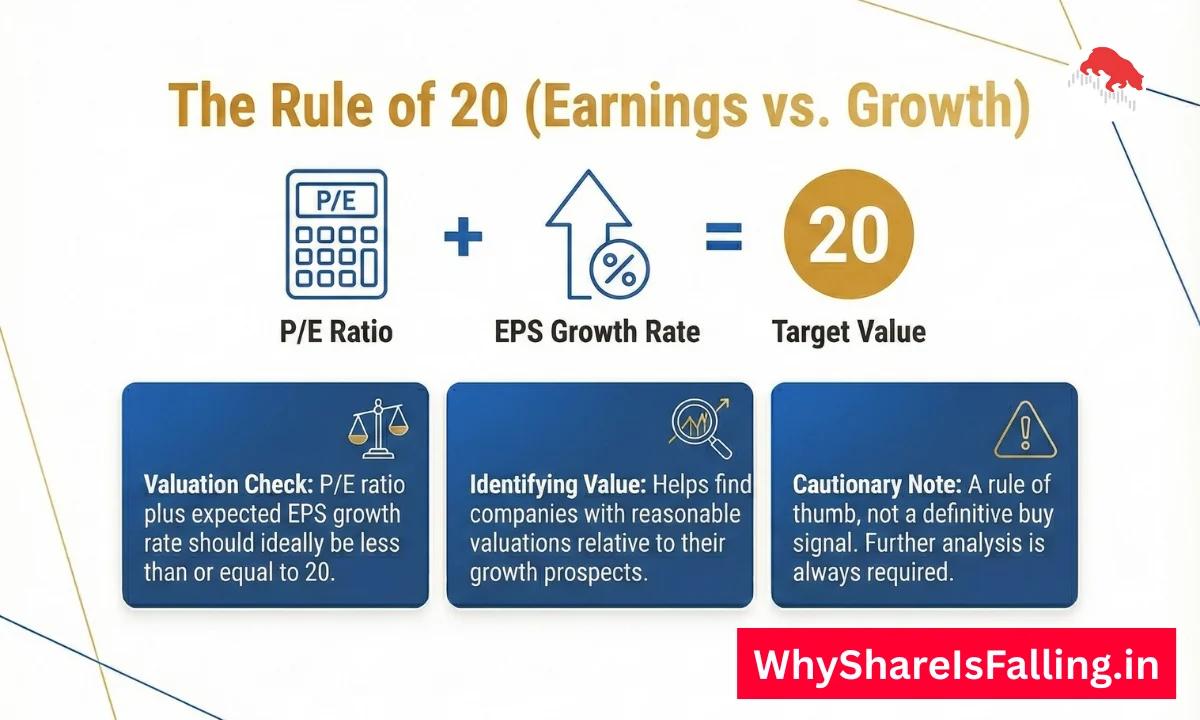
The Peter Lynch Style Lens: Earnings vs Growth
There is another related interpretation. This version is often linked to investor Peter Lynch. It focuses on individual stocks instead of the broad market.
This approach says a stock looks fairly valued when:
P/E ratio ≈ earnings growth rate (percentage)
This relates closely to the PEG ratio. PEG equals P/E divided by growth rate. A PEG value of 1 is often seen as fair value. Below 1 suggests undervaluation. Above 1 suggests overvaluation.
Investors like this measure because it rewards companies with real growth power. For example:
- A stock trading at 35 times earnings with 30 percent growth may still be reasonable
- A stock trading at 20 times earnings with only 5–10 percent growth may be expensive
This is why fast-growing AI-driven companies still attract investor demand. Many believe strong growth can support high valuations over time.
Critics argue that extreme growth expectations rarely last. If growth slows, rich valuations can reset quickly.
One Listicle: Why Investors Admire Growth-Focused Valuation
- It rewards companies that grow earnings at a steady pace
- It highlights stocks that compound value over long periods
- It helps compare companies across sectors
- It filters out stocks that look cheap but grow too slowly
- It allows selective investing instead of buying the broad market
This approach shifts the focus from cheap prices to quality growth.
What People Are Saying Online
Recent discussions on X show cautious sentiment. Many users highlight how the Rule of 20 remains stretched. Some link this to bubble-like pricing. Others argue that the market structure has changed thanks to new technology, productivity gains, and digital business models.
Strategists point out that current readings in the high 20s or low 30s have been rare historically. These levels often came before periods of slower returns or higher volatility.
At the same time, investors praise stocks with strong earnings expansion. Many prefer companies with 15 percent or higher earnings growth at reasonable valuation levels. They believe these businesses can still deliver solid returns even if the broader market cools.
Skepticism remains for ultra-high multiples that depend on long stretches of flawless growth.
Outlook for 2026: Selective Growth Over Broad Market Exposure
Overall, the tone heading into 2026 is one of caution. The Rule of 20 reading indicates the broad market leaves little cushion. Long term investors may need to be selective. This does not mean exiting the market, but rather focusing on companies with sustainable growth at fair prices.
Growth remains the admired factor. But durability matters more than hype.
If earnings continue to expand strongly, markets may stay elevated. If growth slows, valuations may need to reset closer to historical norms.
The Rule of 20 remains a useful signal, even if not perfect. It acts as a reminder that valuation still matters, regardless of market cycles or new themes.
Final View
The Rule of 20 helps investors judge how much optimism is already priced into the market. Today, that optimism remains high. The earnings vs growth approach shows that paying for genuine long term growth still makes sense. Together, these ideas suggest a disciplined and selective strategy is best for 2026.
Long term success may rely less on market timing and more on choosing growth that can last.
Tags: Rule of 20, stock market valuation, PEG ratio, earnings growth, investing strategy, market outlook
[…] Read More: The Rule Of 20 In Stock Valuation: Earnings vs Growth […]